

News
Racial Justice & Migrants’ Rights
August 23, 2024
“Not An Equal Opportunity Virus”
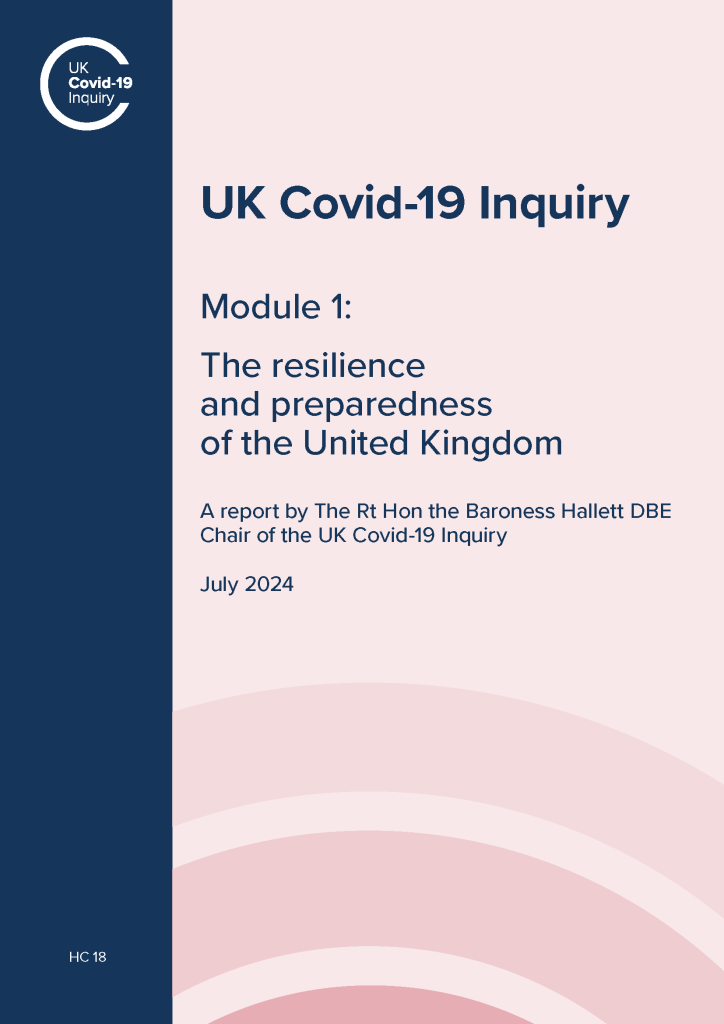
Earlier this month, the Covid-19 Inquiry published its first interim report on the UK’s preparedness for the pandemic. PILC’s Legal Director, Paul Heron, shares his view.
Ten years of austerity and a government on a mission to underfund and undermine its own public services left the health service unprepared and under resourced for the Covid-19 pandemic. The only reason that the NHS was able to respond to it in any meaningful way was due to the herculean efforts of its workers – its doctors and nurses, its porters and cleaners.
In the first report into the preparedness for a pandemic, the chair of the Covid-19 Inquiry, Baroness Hallett, has confirmed as much.
“‘Public services, particularly health and siocial care, were running close to, if not beyond, capacity in normal times. […] in the area of preparedness and resilience, money spent on systems for our protection is vital and will be vastly outweighed by the cost of not doing so.” (p2)
“…it remains the case that the surge capacity of the four nations’ public health and healthcare systems to respond to the pandemic was constrained by their funding.” (p123)
Condemning the government handling, funding and policies of austerity, the report said that “Covid-19 was not an “equal opportunity virus” (p71), explaining that it resulted in a higher likelihood of sickness and death for people who are most vulnerable in society. Citing the report from Professors Bambra and Marmot, the chair of the Inquiry said:
“the UK entered the pandemic with its public services depleted, health improvement stalled, health inequalities increased and health among the poorest people in a state of decline. Had the U.K. been better prepared for and more resilient to the pandemic, some of that financial and human cost may have been avoided…” (p71)
During the initial waves of infections, Britain experienced one of the highest per capita death rates in Europe, resulting in over 225,000 total deaths according to official figures.
But before the Coronavirus outbreak, the government believed the country had a robust healthcare system and a solid pandemic plan capable of effectively handling a disease outbreak. However, the report has found this assumption to be woefully incorrect.
For our clients, the question is: were Government Ministers badly advised, completely out of touch of the impacts of their own austerity policies, or were government ministers criminally negligent?
Kamran Abbasi is the executive editor of the British Medical Journal. He raised an interesting issue in his article about the mishandling of the pandemic. “Murder is an emotive word. In law, it requires premeditation. Death must be deemed to be unlawful. How could “murder” apply to failures of a pandemic response? Perhaps it can’t, and never will, but it is worth considering.”
He questions whether wilfully allowing tens of thousands of premature deaths for the sake of population immunity and the economy is lawful. He asks, “Is inaction, action?”
Currently, crimes against humanity as judged by the International Criminal Court don’t cover public health issues. Abbasi questions if this should be expanded to public health malpractice and include the management and funding of public health prior to and during pandemics.
It was the deliberate mishandling of an infectious disease by ideologically driven governments and ministers that meant hundreds of thousands of people died. The governments at the time (Trump in the US, Modi in India, Bolsonaro in Brazil and Johnson in the UK) were all of the neo-liberal school of economics. All had been involved in driving down public health standards and all believed that Covid-19 was no worse than a common cold.
And it certainly wasn’t the political class who suffered the most. Millions of working-class people and the poorest communities were hardest hit. The then-UK prime minister, Boris Johnson, was even reported as saying that he would sooner see “the bodies pile high” than further lockdown.
If Government Ministers’ failure to act when faced with all the scientific evidence can’t be held as ‘social murder’ or indeed a crime against humanity, could it be considered involuntary manslaughter, misconduct in public office, or criminal negligence?
We must remember: each death represents not just a single tragedy but a multitude of bereaved families, shattered lives, long-term illnesses, and economic devastation.
Some may think that public inquiries are a way of government ‘kicking the can down the road.’ However, this first report from the UK Covid-19 Inquiry provides a stern warning to the complacent politicians and leading career management civil servants. Our clients hope it sets the tone to make strong recommendations to the government who must act on them.
We would like to see the Inquiry recommend that the current UK government propose mechanisms, statute and regulations (that could involve the International Criminal Court) to broaden its remit to cover deliberate state failings in global pandemics.
-------
The Covid-19 pandemic delivered a shock to every aspect of the system we live under. It has shone a light on the failings of government and brought social inequality in the UK into sharp relief.
PILC are representing eight organisations in Modules 2, 3 and 4 of the Inquiry. You can read more about it here.
We will not rest until we see a fairer and more equitable society.
Make a donation today to support our work:
More ways to give


244-254 Cambridge Heath Road London E2 9DA
Phone: 0203 559 6342
Contact us
© Public Interest Law Centre
Charitable Incorporated Organisation in England & Wales - no: 1192355
Registered office: 244-254 Cambridge Heath Road, London, E2 9DA