

News
Gentrification
April 14, 2025
Opportunity Areas, Opportunity London
How the Mayor of London turns an urban planning device into a £22 billion “investment prospectus”
Guest post by Dr Christine Hannigan
'Opportunity Area' Map
In mid-March, the Mayor of London headed to Cannes for MIPIM, the “world’s most influential property event,” in the hopes of attracting “private finance” to invest in major transport projects like the Bakerloo Line Extension, mixed-use developments of student housing, rental housing, workspaces, leisure and tourism, logistics, and “urban sciences.” This trip to Cannes follows a “high-level delegation” touring Singapore, Malaysia, Hong Kong, Seoul, and Tokyo for 3 weeks with a similar agenda.
This was all excitedly announced on Opportunity.London, a website resembling the Greater London Authority’s in branding and tone, rehashing the same rote phrases about London being a great place to live, work, visit, study. In the same press release, Sadiq Khan boasted London is not just the best, period, but also the best city to invest in...and that Londoner’s “desperately” need affordable homes.
Despite its name and close associations with the GLA, however, Opportunity London is not a public endeavour – it is a spinoff of London & Partners (.com), which is the Mayor’s “promotional agency,” created by Boris Johnson to perpetuate the investment "legacy” of the 2012 Olympics. London & Partners gets £20 million of GLA funding annually to fulfill its mission of bringing more “investment” into the city, including by operating several overseas offices, most of them in China, India, and the United States.
The logos on Opportunity London’s Partners and Supporters page can be spotted out on the street, on hoardings enclosing unpopular construction sites all over the city: multinational corporations like Ballymore and Lendlease, and one of the most powerful landowners in Britain, the Crown Estate. Among the partners are also special-purpose development corporations, who as seemingly-single entities conceal webs of foreign investors, construction and property management companies (like the Battersea Power Station and Old Oak and Park Royal Development Corporations) with monopolized power over large swathes of land. Other “partners” are Microsoft, investment firms like Delancey and, curiously, AirBnB, whose business model ostensibly complicates the supply for homes Londoners “desperately” need.
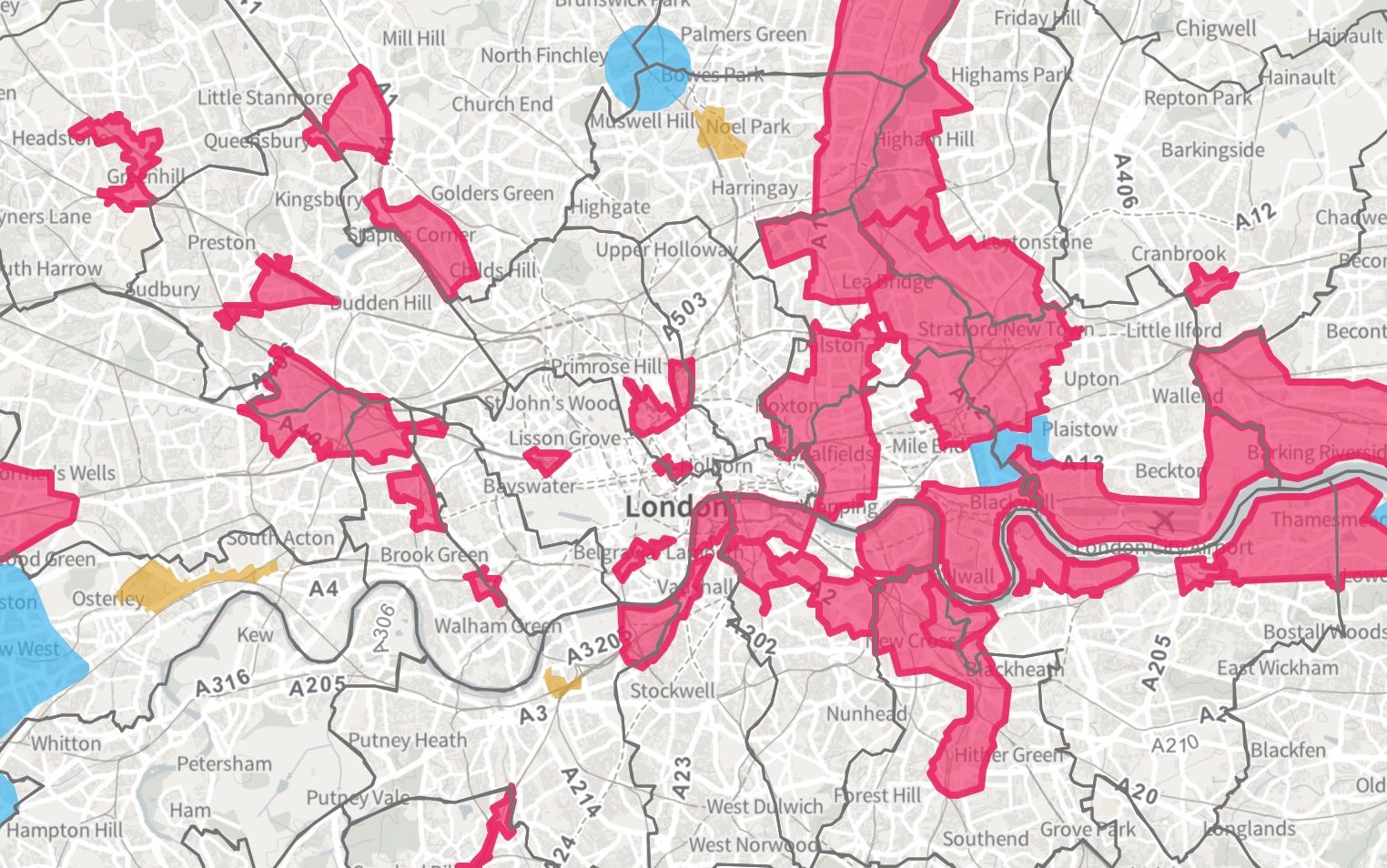
At MIPIM, the Mayor debuted 20 sites comprising Opportunity London’s 2025 “investment prospectus.” These sites are drawn from Opportunity Areas, which the Mayor designates in each iteration of the London Plan. Opportunity Areas were first introduced in 2004.. They are generally hundreds of hectares with the expectation they can provide some combination of 2,500 new homes or 5,000 new jobs. The projections transcend local planning needs in favour of London’s “strategic” goals, their boundaries often crossing into separate planning jurisdictions. Today, nearly one-third of London’s surface area falls within 47 Opportunity Areas, many in east London.
Land ownership of these sites is usually limited to a single or few corporate “investors.” Try as they might to achieve “placemaking” via earnest consultancies who claim to know about community, their efforts at “vibrancy” and “diversity” cannot overwrite a private development’s core function of extracting maximum profit for shareholders, instead finding security in predictable, sterile homogeneity. This is conveyed in the imagery of the investment prospectus, which has more artificial renderings than actual photographs. Most perspectives are high above and far away, or buildings imagined at the ground-level, devoid of any activity.
With the Mayor and his deputies traipsing around the world hoping to seduce “private finance,” as if “finance” is an embodied actor in and of itself, it’s unclear who is advocating for ordinary Londoners’ needs. How profit extraction motivates design is evident across Opportunity Areas. One example is the Northern Line Extension. The Battersea Power Station tube stop, which is financed by the complex, international consortium hidden under the name of the Battersea Power Station Development Corporation, is beside the River Thames outside the power station-turned-luxury-mall, leaving the Opportunity Area’s southern hinterlands (where the development’s 9% affordable housing was built, off-site) with low Public Transport Accessibility Levels. The station fulfills only the preferences of the developer, missing the obvious chance to exchange with the Victoria Line and the Mildmay and Windrush Overground lines.
Still south of the river but further east is the Lewisham Gateway. Lewisham Council’s own Strategic Housing Market Assessment recognises the direst housing need is for affordable 3- and 4- bedroom family homes, yet Lewisham Gateway – the largest development in an 813-hectare Opportunity Area – is mostly studio and 1-bedroom rentals. It stands on public land leased to Muse for 250 years. Muse is part of the Morgan Sindall Group, a construction consortium whose majority shareholders include Blackrock and JP Morgan. Lewisham Gateway is managed by Get Living PLC. Its shareholders include an Australian pension fund and other financial institutions, including Opportunity London partner Delancey. In violation of the Council’s own 50% affordable housing policy for new builds, only 106 of the 1,000 new homes are. Thousands of families on Lewisham’s housing waitlist live in overcrowded conditions, but the Council still gave planning permission.
The prospectus’ messaging is inconsistent about affordable housing targets or caps. Barking Riverside, which is anticipated to have 20,000 homes in one of the poorest Boroughs, doesn’t mention it at all. “Affordable housing” is a slippery concept, but these projections don’t carry much weight anyway - Opportunity London’s Partners have track records of evading them, such as Lendlease in Elephant & Castle and Ballymore in several developments in Newham, Canary Wharf, and Edgware.
Opportunity London promises investing in London is “liquid and secure, offering long-term returns,” but one of the mechanisms to achieve this comes at the direct expense of addressing Londoners’ needs. Affordable housing targets are negotiated downwards in the name of “viability,” a misleading term that simply refers to the developer’s desired return. A development being “unviable” does not necessarily suggest bankruptcy; just that a private investment won’t generate a particular profit. That threshold has inched up over the years, from 12 to 15 to 17 percent, sometimes as high as 25.
In viability assessments’ formulae, which are often unavailable or heavily redacted for public release, the developer’s returns are kept as a fixed input, whereas affordable housing and other infrastructural contributions are flexible variables, to be incrementally negotiated downwards at each phase of construction. Although they seem dry, technical exercises, viability assessments are a tool (often written by financial institutions themselves) that transform public authorities into guarantors of private speculative real estate investment.
As the 35% Campaign reported, Notting Hill Genesis (a member of the Old Oak and Park Royal Development Corporation), claimed a £13.5 million return (or 5.22%) on one of their other projects, the Aylesbury Development in Southwark, made the whole scheme unviable- they wanted to make £24 million, or a 14.55% return. The Mayor of London conceded and gave Notting Hill Genesis an addition £13.72 million on top of the £28.79 million grant it had already received (and £13.5 million anticipated profit), to build only 17 more affordable homes.
Rather than being happenstance victims of privatisation, local authorities, the GLA, and Mayor of London actively forfeit their responsibilities and subjugate democratic planning procedures. Public officials turn their backs on their constituents’ “desperate” needs amid housing and cost of living crises, instead holding open the “investors front door” to "the most attractive city in the world to invest.”
Bio: Dr Christine Hannigan researches the financialisation of land and public goods in London. She is currently involved in Save Soanes, a grassroots campaign working to get Setpoint London East, a children’s outdoor education charity, a long-term, secure lease of the Soanes Centre from Tower Hamlets Council.

We will not rest until we see a fairer and more equitable society.
Make a donation today to support our work:
More ways to give


244-254 Cambridge Heath Road London E2 9DA
Phone: 0203 559 6342
Contact us
© Public Interest Law Centre
Charitable Incorporated Organisation in England & Wales - no: 1192355
Registered office: 244-254 Cambridge Heath Road, London, E2 9DA