

News
Public Inquiries
March 5, 2026
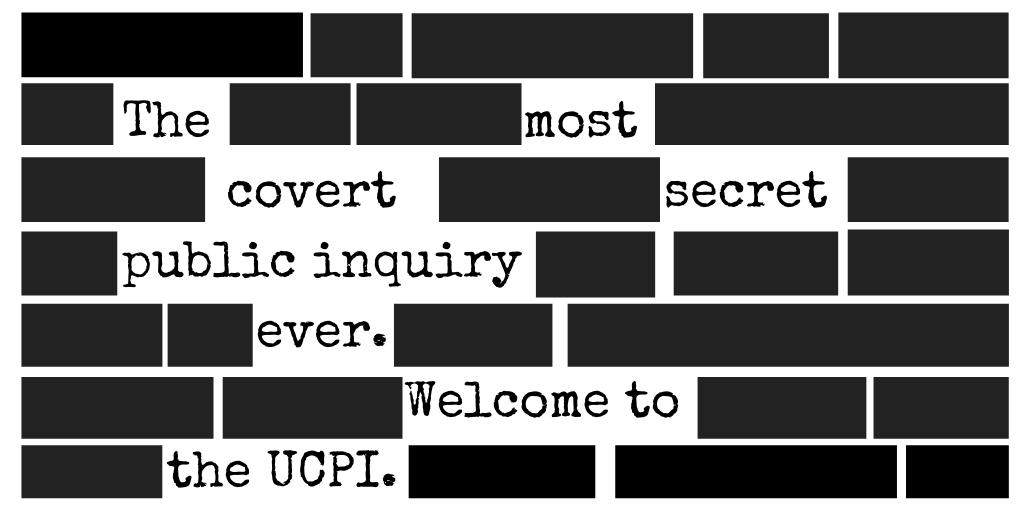
Spycops Inquiry: secrets and lies
Paul Heron, solicitor at PILC, represents Core Participants including Stop the War Coalition, the Campaign for Nuclear Disarmament, Youth against Racism in Europe and several socialist activists. In this article he reflects on the latest hearings at the Spycops public inquiry and in particular recent comments by the Chair of the Inquiry.
On Wednesday 25th February 2026 ‘Lyndsey’ a woman deceived into a relationship by Carlo Sorrachhi an undercover officer of the Metropolitan Police Service gave evidence to the Undercover Policing Inquiry (UCPI). Her evidence was a combination of searing truth, sharp political analysis, very moving and at times humorous. Maybe it’s something about scousers that can combine all these elements.
At the close of the of several hours of oral evidence Sir John Mitting had the following to say:
“Can I say one further thing to you personally, and so that the wider world can understand it – what the wider world hears and what you hear on audio video link or what if you are here in person is the open side of undercover policing. There was a closed side which will have to remain closed and might if everyone knew about it put matters in a slightly different perspective. It doesn’t of course justify a lot of the things that you and I have heard about on the open side. But have got to be kept in balance. At any rate sorry about long speech.”
At first glance, Mitting’s remarks appear courteous and empathetic. However, entrenched within his comment are three connecting themes that should deeply concern Core Participants (CPs), lawyers and indeed those seeking truth and accountability.
1. The Myth of Neutral Balance
For my clients Mitting’s language of “balance” is not neutral. It reflects a legal framing in which state misconduct must be weighed alongside state necessity. From their standpoint this will be an all too familiar manoeuvre. First, the British state seek to present itself as an impartial arbiter between competing interests, yet secondly and in reality those elements of the state (including the judiciary) will structurally defend the establishment.
Undercover political policing in the UK, through units such as the Special Demonstration Squad (SDS)and National Public Order Intelligence Unit (NPOIU) were not created in a vacuum. Political Policing targeted trade unionists, anti-racist groups, environmentalists, socialists, women activists and family justice campaigns. The targets were not criminal conspiracies, they were political movements challenging state and corporate power. To invoke ‘balance’ implies that these movements constituted a threat requiring certain counter measures. That very position (something my clients have been fighting against) reproduces the logic of countersubversion that justifies infiltration.
For my clients it is of course always the position that they have sought to question. Who defines “threat,” who defines “balance,” and whose interests are being protected? Historically, the answer is clear, the security state polices the boundaries of dissent to protect the establishment itself.
2. The Closed Material Issue
As a public inquiry the UCPI has had an unprecedented volume of closed material and closed hearings. This is not incidental. It reflects the dominance of a national security logic over public accountability. This was something that ‘Lyndsey’ very effectively argued against when Mitting provided his ‘reasonable’ view. In response she said:
“If the goal is to allay public concern about this widespread abuse it should be more open, should be public. I think the police and the security services constantly harping on about national security and how things need to be kept from the British public, personally I don’t subscribe to that point of view. So yes, I obviously haven’t seen the material you have seen, so I am not speaking from full knowledge. I would like to be speaking from full knowledge. But yes, I think governments need to have more faith in the population that we are not just all going to go and riot and commit crime if we are told the truth, rather than be treated like children, you know, to be given just a bit of information.”
Yet, Mitting’s suggestion that the secret material will cast events in a different light is troubling for two reasons:
First, it undermines the public nature of a public inquiry which derives its legitimacy from openness. Survivors, core participants, and the public are entitled to see and challenge the evidence. If material is withheld, then findings rest on information that cannot be tested, contested, or democratically scrutinised.
As a test, here is an example. Very early on in the UCPI Mitting described the deployment of ‘Rick Gibson’ as “uneventful.” Core Participants ‘Mary’ and Richard Chessum both involved in the Troops Out Movement (TOM) came forward and were able to test this and expose this assertion. It became clear that ‘Rick Gibson’ was a UCO who engaged in multiple sexual relationships during his deployment. He also infiltrated TOM, at one stage effectively becoming its de facto leader, and sought to undermine and derail the organisation from within.
Mitting has used “secret hearings” regularly, and for my clients it appears that there is unquantifiable “secret evidence.” What does this mean for Core Participants? Not only are they prevented from considering and responding to the full body of material, but it also undermines basic rule-of-law principles. As a result, the British state has access to the complete picture, while those who were targeted are permitted a partial view. In these circumstances, closed evidence operates as a protective barrier for state interests rather than a vehicle for Core Participants to seek redress and accountability.
Secondly, it reproduces the logic of “secret justification” for political policing.
The idea that the secret intelligence that Mitting refers to might place wrongdoing in a different light or lessen its seriousness echoes the idea that national security is in some way exceptional. We are asked to trust that there are reasons, compelling but undisclosable, that explain why political policing was completely justified. My clients are not convinced in the slightest.
Yet, this is the same logic that enabled abuses in the first place. The SDS justified and embedded into its very strategy sexual relationships, identity theft of dead children, infiltration of grieving families, and the targeting of anti-racist and socialist organisations on the basis for the need of secret intelligence assessments. Mitting is reproducing this strategy.
Mitting has kept disclosure secret, so much so even the lawyers acting for victims don’t know the extent. It cannot be examined. It cannot be democratically evaluated. It cannot be challenged or explained.
3. The Risk of Managerial and Political Shielding
The most worrying aspect of Mitting’s statement is the possibility that closed material will be used to soften conclusions about senior management, civil servants, an/or leading politicians.
If secret evidence suggests that infiltration was “necessary,” the focus moves from wrongdoing to strategy. Instead of asking why democratic movements were targeted in the first place, the UCPI risks asking only whether the tactics were proportionate.
That reframing serves the establishment. It narrows the question to management improvements rather than confronting the political question, why was dissent equated with subversion?
The UCPI is not simply a fact-finding exercise. It has been a site where my clients have contested the machinery of state power. Core Participants have used it to expose institutional sexism, racist surveillance, and political repression.
Mitting’s comments appear to indicate his thoughts on not only the closed material, but also the hearings themselves becoming a mechanism through which that stabilisation and that justification for political policing will occur.
The phrase Mitting uses, “…put matters in a slightly different perspective” is especially revealing. It marks a shift about how political policing should be understood. The Chair is not merely reporting facts, he is positioning how they should be understood. The Chair is not merely reporting facts, he is positioning how they should be understood. If that positioning draws on undisclosed material the ability of Core Participants and their lawyers becomes difficult to challenge.
Conclusion
Sir John Mitting’s remarks are concerning not because they acknowledge secrecy. They are concerning because they suggest that secrecy will be used to re-set what Core Participants have been able to expose in their written and live evidence.
When the open evidence already shows serious and widespread abuse, referring to secret material can turn real accountability into little more than damage control. From my client’s perspective, this shows how the state works in two ways at once, first it admits some wrongdoing, but then secondly at the same time it protects its power to police and control.
The central question is not whether some closed material exists. It is whether a democratic society can accept conclusions about political policing that rely on evidence the public cannot see.
We will not rest until we see a fairer and more equitable society.
Make a donation today to support our work:
More ways to give


244-254 Cambridge Heath Road London E2 9DA
Phone: 0203 559 6342
Contact us
© Public Interest Law Centre
Charitable Incorporated Organisation in England & Wales - no: 1192355
Registered office: 244-254 Cambridge Heath Road, London, E2 9DA